
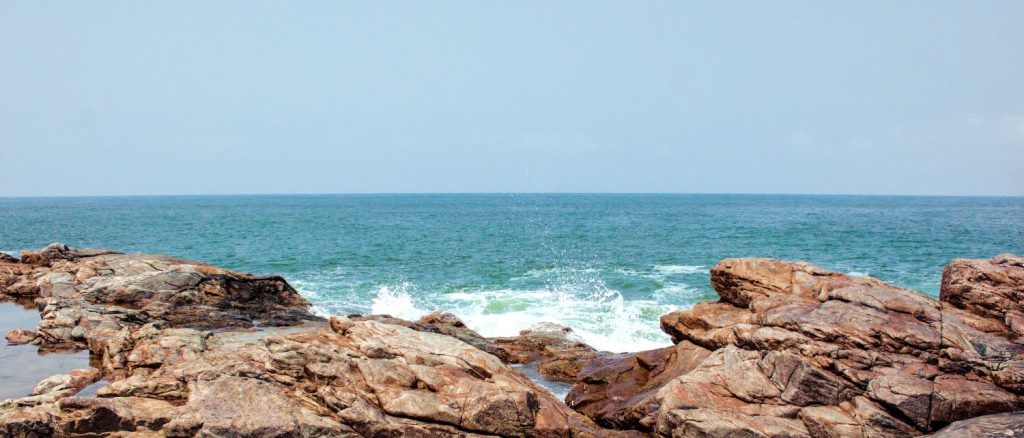
Portu Corallo Beach

Between Masua and Nebida and a few miles from the beautiful Pan di Zucchero sea stack, lies the small beach of Portu Corallo, a true gem of the Iglesiente region, wild and not overcrowded. The small cove is framed by a cliff with warm, reddish tones, above which the dense Mediterranean vegetation extends, standing out for its green color comparable to the splendid color of the crystal-clear waters. The beach is characterized by mixed pebbles and sand, and the seabed is mostly rocky, with rocks that emerge just below the water’s surface.
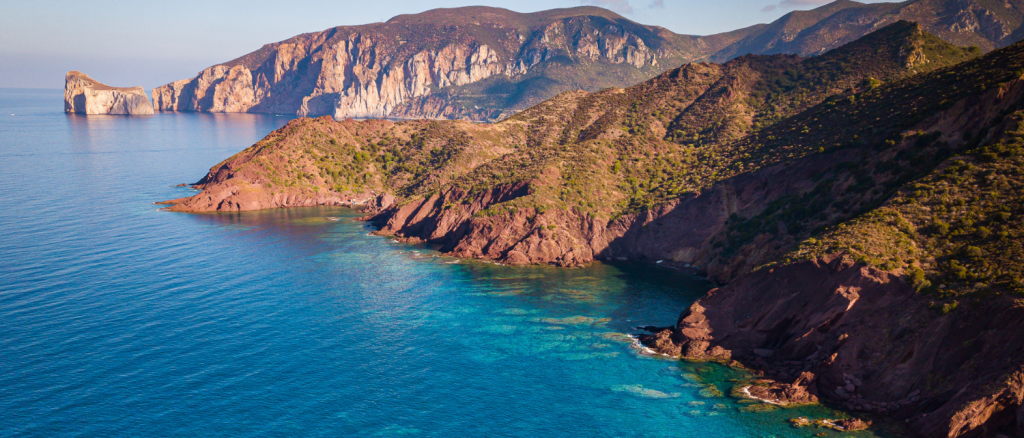
Porto Ferru Beach
Porto Ferru Beach offers a wonderful wild and unspoiled environment. Completely immersed in nature and protected by two cliffs, the cove is characterized by fine sand with amber and golden tones. The seabed is mostly sandy and shallow, but what really fascinates bathers is the polychromy of its waters with shades ranging from emerald green to shimmering blue.
Portu Banda Beach
Portu Banda is located just outside the town of Nebida. It is a small cove approximately 100 meters long, ideal for those who want to go fishing, diving, or sunbathing. A must-visit for SUP lovers, its layout allows for a natural path around the three rocks that rise just in front of the beach while, behind it, nature dominates the landscape with Mediterranean scrub. Portu Banda is characterized by dark sand with the presence of pebbles smoothed by the sea. The cove is protected by high cliffs that drop down to the sea, a dark red color contrasting with the shimmering green of its crystal-clear waters. The beach is easily accessible by car thanks to the parking lot located just a few meters from the beach.
Cala Domestica
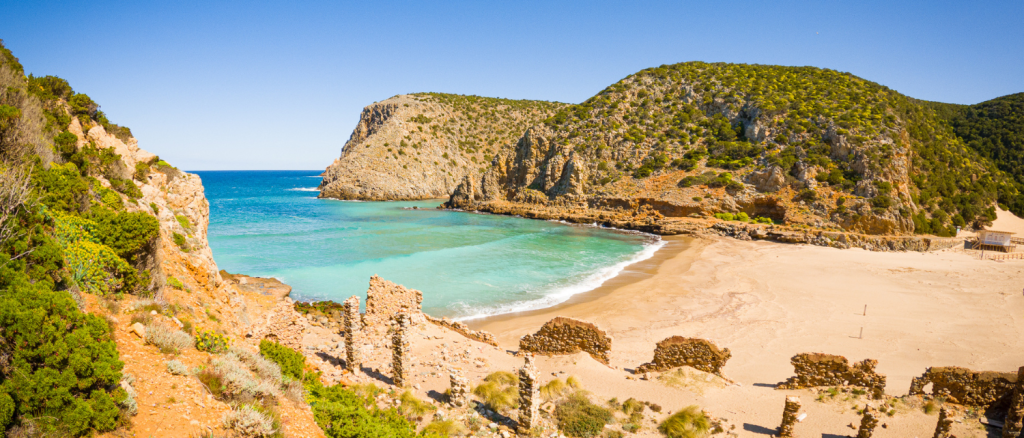
Cala Domestica is located on the southwest coast of Sardinia, two kilometers from Buggerru. The beach enjoys a unique landscape where the mining history of the area merges with the wild nature and one of the most beautiful seas in Sardinia, with turquoise and blue colors and shallow, sandy seabeds. Until 1940, minerals extracted from the mines were shipped from Cala Domestica. Ruins of warehouses, deposits, and galleries dug by miners are still visible on the beach. One of the galleries dug in the past now leads to a second cove called “La Caletta.” The larger cove is naturally framed by high cliffs and dominated by an eighteenth-century Spanish tower from which you can admire unmatched views. It is a deep inlet with a wide golden sand beach. Cala Domestica has a large parking lot, a camper stop area, a refreshment point, an access walkway and a camping site.
Municipal Historical Archive

The Municipal Historical Archive is located on Via delle Carceri in the former district jail, built in 1794 and now a place of study. Inside it is kept the oldest existing document concerning the city: the “Breve di Villa di Chiesa”. This is the statute of Villa di Chiesa, the ancient name of the city of Iglesias. It was elaborated at the time when Iglesias was under the dominion of the Pisana family of Donoratico, dedicated to the exploitation of the Sulcis mines. The Breve was ratified in 1327 by Alfonso d’Aragona after the conquest of the city. The Breve contains regulations that govern the entire life of the Iglesian community, from urban planning regulations to rules on the proper conduct of markets and goods sold there, from the regulation of social life to the provision of penalties to be imposed on those who committed different crimes.
Diocesan Museum

The Diocesan Museum of Iglesias is located in the basement of the apse area of the Cathedral of Santa Chiara and opened in November 2013. The museum houses artifacts related to the history of the cathedral and liturgical objects from its Treasure, which are exhibited alternately with other thematically studied collections. The museum has periodically exhibited book and documentary shows, collections of liturgical objects, and statues, often together with Iglesian liturgical festivities, devotional practices, and ecclesiastical traditions. It is managed by volunteers from the Diocese of Iglesias and is open on days and hours that change periodically. The museum can be visited by appointment by calling +39 0781 435779 or sending an email to museodiocesano.iglesias@gmail.com INFORMATION Address: Via Duomo, 09016 Iglesias SU Telephone: +39 0781435779 E-mail: museodiocesano.iglesias@gmail.com
Mining Institute Museum

The Museo Istituto Minerario (Mining Institute Museum) includes two museums: the Museo dell’Arte Mineraria (Mining Art Museum) and the Museo di Mineralogia (Mineralogy Museum). In 1998, some “mining men” created the Museo dell’Arte Mineraria. The aim was to preserve and show many of the things that allowed the miner to dominate the rock and, by studying and creating new equipment, become the architect of a mining culture that for centuries has been the center of social and economic life in large parts of our island and not only. In this museum, it is possible to see machinery that were already used in mines at the end of the 1800s, or flotation cells still used today in mineral enrichment facilities, as well as about 400 m of galleries that, started in 1934 as a laboratory for students, became a safe air raid shelter in the last years of World War II. The Istituto Minerario was founded in 1871 under the auspices of the Engineer Quintino Sella, Minister of Finance of the Lanza Government. The entire museum collection includes almost 3800 mineralogical, petrographic, and fossil specimens from all over the world, supplemented by a collection of about a hundred archaeological finds from mining activities of Nuragic, Phoenician-Punic, Roman, Pisan medieval, and Aragonese era. A collection of specimens that represents the specific identity of the Iglesiente territory and collects the didactic, mineralogical, and paleontological collections consisting of local minerals and fossils and specimens from deposits distributed throughout the regional, national, and global territory. In April 2018, the new installation of the first room of the Museum titled “The Bricks of the Earth” was inaugurated. Currently, work for the second and third rooms are in progress. The “The Bricks of the Earth” room introduces the visitor to the world of mineralogy through a multimedia installation that exhibits a careful selection of minerals, taken from the entire collection, and describe, with a sequence of images, specially shot and displayed through monitors and video projections, the formation of the Iglesiente geographical landscape by the four natural elements, water, air, earth, fire, and the flow of geological time that marks the slow process of earth formation from its origins. English tours at 11:30 am and 4:30 pm. Tickets to visit the Museo Istituto Minerario can be purchased directly on our website by clicking here. INFORMATION Address: Via Roma, 45, 09016 Iglesias SU Telephone: +39 0781274507 E-mail: infoturistiche@comune.iglesias.ca.it
Ignoto Militi Museum

Housed in the headquarters of the Associazione Combattenti e Reduci (Combatants and Veterans Association), which was inaugurated in 1938, the museum showcases objects and materials from the First and Second World Wars, as well as combat and everyday life items used by the Fanti di Iglesias, spread across two floors of the museum. The exhibition is based on private and association collections, and a thematic library will soon be inaugurated as well. The recovery of the old membership database and various “Patronato” activities carried out over time by the Association is also important. The museum can be visited by appointment by calling +39 389 9445525 (Ariu, Federico) or by sending an email to iglesias.sez@combattentiereduci.it INFORMATION Address: Via Antonio Gramsci, 3, 09016 Iglesias SU Telephone: +39 389 9445525 E-mail: iglesias.sez@combattentiereduci.it
Costume and Traditions Museum

The Costume and Traditions Museum of Iglesias was inaugurated in 2019 thanks to the ethnographic and anthropological heritage collected and preserved for years by the master Priola, owned by him and acquired through donations from families in Iglesias. The museum preserves costumes, jewelry, and household items from the past. In the ground floor room, visitors can admire everyday utensils such as baskets, jars, carved and painted chests, looms, grinding stones, and presses. In the first-floor room, visitors can admire the traditional costume of Iglesias. Regarding the traditional women’s dress, there are several types according to social class or a woman’s condition at a particular moment in her life. For example, “Sa Nostrada” was the noble or bourgeois woman who wore the dress that best identified with Iglesias. The “Massaja Antiga” was the landowner. Beautiful is the dress of “Sa Bagadia” or the young lady. The men’s outfit includes a white shirt with a wide collar, a blue or black corset, a black orbace or cloth jacket, ankle-length pants, also in black orbace, and finally “Sa Berritta” or “Su sombreri,” the headgear. On the side, there are many precious pieces, including shawls and corsets, and in the central part, jewels, including earrings, pendants, brooches, and buttons are displayed. The museum can be visited every day by reservation at the Tourist Office by calling +39 0781274507 or by sending an email to infoturistiche@comune.iglesias.ca.it INFORMATION Address: Via Giuseppe Mazzini, 2, 09016 Iglesias SU Opening Hours: Tutti i giorni previa prenotazione all’Ufficio del Turismo di Iglesias Telephone: +39 0781274507 E-mail: infoturistiche@comune.iglesias.ca.it
Seddas Moddizzis Mining Village

The Asproni Mining Village, also known as Seddas Moddizzis, was built at the beginning of the twentieth century to house the employees of the Gonnesa mine. It consists of about a dozen buildings, immersed in an area of great environmental interest. The access road to the village leads to the square where there are the Asproni residence, which has an internal courtyard and the central tower, and the management building. In addition to the workers’ houses, the cellar-shop near the square is of interest, with a high arched porch currently used as place of events, and the church of Santa Barbara, with exposed stonework, which is located in an elevated position, on the northern border of the village. To visit the village, it is necessary to book a guided tour at +39 347 3213028 or +39 331 7726838, send an email to villaggiominerarioasproni@gmail.com or visit the website www.villaggiominerarioasproni.it INFORMATION Address: Località Seddas Moddizzis, Iglesias 09016 CI Telephone: +39 347 3213028 | +39 331 7726838 E-mail: villaggiominerarioasproni@gmail.com Website: www.villaggiominerarioasproni.it